Quick answer: EA published eight cricket games for PC and console between 1996 and 2006, finishing with the cult favourite Cricket 07. It walked away because the series never got anything close to FIFA money, because cricket licensing means negotiating with dozens of separate boards instead of one, because the sport's biggest markets had very low rates of legitimate game purchases at the time, and because Codemasters took the official ICC World Cup rights in 2007. EA did keep making cricket games after that, just not the kind anyone remembers: Cricket 10 and Cricket 11 were mobile-only releases in 2009 and 2010.
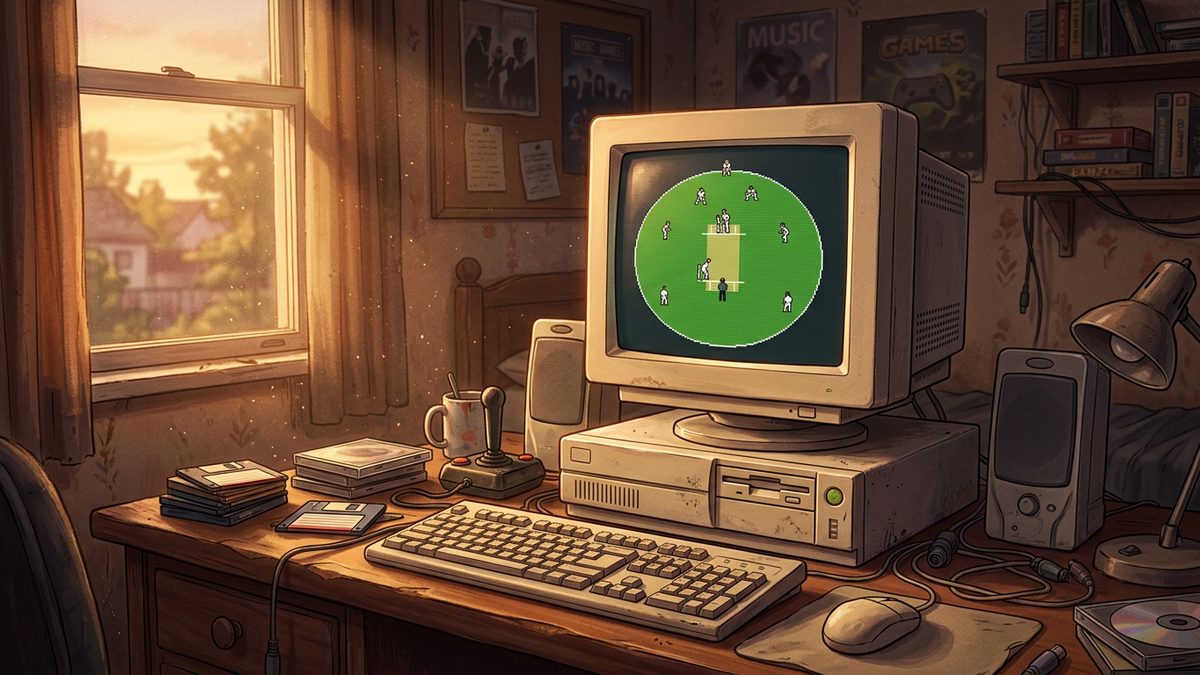
Original illustration created for IGGG Guides. Not a screenshot of any game.
A game from 2006 that millions of people still have installed
For a whole generation across India, Pakistan, Bangladesh and Sri Lanka, one game defined cricket on a screen. Not the newest one. Not the best looking one. EA Cricket 07, a title that came out when the PlayStation 3 hadn't launched in most of the world yet.
Twenty years on, people are still patching it. Still swapping roster files. Still arguing about whether the 2007 or 2014 community patch handles spin better.
That isn't as strange as it sounds, by the way. Valve's own platform data shows that 40% of all Steam playtime goes to games eight years or older, which is something we dug into properly in our piece on why gaming feels boring lately. Old games holding on is normal. What's unusual about Cricket 07 is that it has no successor at all. EA simply stopped, and nobody else with that kind of budget stepped in.
So what actually happened? The honest version involves a licensing structure nobody could untangle, a studio that never got the money it needed, a rival that grabbed the World Cup rights, and a market where almost nobody was paying. Here's the whole story, with the bits that usually get repeated wrong sorted out.
Cricket games did not start in 1992
You'll see it written everywhere that Beam Software's International Cricket was the first cricket video game. It wasn't, and it's worth getting right, because the real history is older and more interesting.
| Year | Game | Developer | Why it matters |
|---|---|---|---|
| 1983 | Test Match + One Day Cricket | CRL Group | One of the earliest known cricket games, on the ZX Spectrum |
| 1984 | Cricket 64 | CRL Group | Early graphical cricket on the Commodore 64 |
| 1985 | Graham Gooch's Test Cricket | Audiogenic | The first cricket game built around a named player endorsement |
| 1992 | International Cricket | Beam Software | The first cricket game on the NES, and Australia-only |
| 1994 | Super International Cricket | Beam Software | SNES sequel, and the direct ancestor of EA's series |
Beam Software was based in Melbourne, and International Cricket was one of only a handful of NES games made specifically for the Australian market. It shipped exclusively there, distributed by Mattel's Australian arm. Nobody tried to sell it in North America, Japan or Europe for an obvious reason: baseball owned the first two, football owned the third.
Beam had no player licensing either, so names got nudged just far enough to be legally safe. Ian Healy turned into "I Hilly". That trick of scrambled near-miss names would follow cricket games around for the next fifteen years, and it's going to come back later in this story.
The 1994 SNES follow-up, Super International Cricket, was the better game. Fast bowlers could move the ball in the air and off the seam, batsmen could leave the crease, and if you failed to duck a bouncer you'd go down clutching your ribs. You'll often read that it hit number one in the sports charts in Australia and the UK. We couldn't trace that to any primary source, so treat it as a popular claim rather than a confirmed one.
Every EA cricket game, accurately listed
This is where most articles on this topic fall apart, mixing up studios and dates. Here's the full list, checked against Wikipedia, PCGamingWiki and MobyGames.
| Title | Released | Developer | Platforms |
|---|---|---|---|
| Cricket 96 | 1995 to 1996 | Beam Software | MS-DOS |
| Cricket 97 | Jan 1997 (AU) | Beam Software / Melbourne House | PC |
| ICC Cricket World Cup England 99 | 1999 | Creative Assembly | PC only |
| Cricket 2000 | 24 Mar 2000 (PS1), 19 May 2000 (PC) | Creative Assembly (PC), Krisalis (PS1) | PC, PlayStation |
| Cricket 2002 | 1 Feb 2002 (PS2), 28 Jun 2002 (PC) | HB Studios | PC, PS2 |
| Cricket 2004 | 12 Mar 2004 | HB Studios | PC, PS2 |
| Cricket 2005 | 1 Jul 2005 (EU), 12 Jul 2005 (AU) | EA Canada and HB Studios | PC, PS2, Xbox |
| Cricket 07 | 14 Nov 2006 | EA Canada and HB Studios | PC, PS2 |
| Cricket 10 | 23 Oct 2009 | Published by EA Sports | Mobile (J2ME) |
| Cricket 11 | 2010 | Published by EA Sports | Mobile (J2ME) |
Correcting a very common myth: you'll read everywhere that EA never touched cricket again after 2007. Not true. Cricket 10 and Cricket 11 came out in 2009 and 2010 for mobile phones. They were small Java releases for the Nokia era and almost nobody remembers them, but EA's cricket output didn't technically stop in 2006. It stopped on PC and console.
The Beam years, and the handover
Cricket 96 was basically Super International Cricket rebuilt for DOS, which tells you how much time anyone had to innovate. Cricket 97 was the real step up, moving into 3D environments with Richie Benaud on commentary and Ian Botham alongside him. For 1997 that was genuinely impressive work. You'll see a figure of 500,000 copies sold attached to it in a lot of articles. We couldn't find a primary source for that number, so we're flagging it rather than repeating it as fact.
After 1997, Beam was done with cricket.
In 1999 England hosted the World Cup, and Australia beat Pakistan in the final at Lord's. EA had Creative Assembly, then known for rugby and AFL games rather than the Total War series they'd become famous for, build ICC Cricket World Cup England 99 for PC. That one mattered for a reason beyond the game itself: it was the series' first title directly tied to the ICC, which meant real licensed names.
Cricket 2000 followed, and here's a correction worth making because it's repeated constantly. It was not developed by Visual Sciences. Creative Assembly handled the PC version, and Krisalis Software handled the PlayStation port separately. Reviewers at the time rated its bowling highly, with some arguing it stayed better than what came in 2002 and 2004.
HB Studios takes over, and the series finally grows up

Original illustration created for IGGG Guides. Not a screenshot of any game.
From 2002 onward, a Canadian studio called HB Studios ran the series. They were young, founded around 2000, and better known for EA's rugby games. Cricket 2002 arrived on PS2 first in February, with the PC version trailing seven months behind in June. It was the series' first proper 3D console outing and the first that felt like it was reaching for simulation rather than arcade.
You'll often read the team was nine people. We couldn't verify that figure either. The broad point survives without it, because what EA was spending on cricket is visible in the games themselves rather than in any staff count.
Cricket 2004 brought the Confidence Meter, where a batsman grew more dangerous the longer they survived and the better they timed their shots. That was a smart, cricket-specific idea, and it's the sort of mechanic that only comes from people who actually understand the sport's psychology. It also, awkwardly, arrived in a game whose visuals were bad enough that IGN handed it the "Worst PlayStation 2 graphics" award. Both things are true at once, and that tension is the whole story of EA Cricket in one release.
Cricket 2005 came from EA Canada and HB Studios together, across PS2, Xbox and PC, with region-specific covers: Adam Gilchrist in Australia, Daniel Vettori in New Zealand, Andrew Flintoff in England. It's also the entry with a detail almost nobody mentions, and it matters enormously for understanding what came next. Cricket 2005 was the last EA cricket game with all real player names. It had licensed players but unlicensed kits, which is the exact opposite problem its rival had.
Worth noting: the claim that Cricket 2005 ran on the FIFA engine shows up in a lot of write-ups, and we found nothing to support it. Cricket 2004 is documented as using RenderWare, which was EA's general-purpose middleware at the time rather than anything FIFA-specific.
Cricket 07, and why it stuck
Released 14 November 2006 for Windows and PlayStation 2, developed by EA Canada with HB Studios, with Andrew Flintoff on the cover and commentary from Mark Nicholas and Richie Benaud. It added a dedicated Ashes mode on top of the usual World Championship, World Series and knockout formats.
On paper it's an incremental update. In practice it became the one everybody kept. A few reasons for that, and only some of them are about the game:
- The control scheme clicked. Full command over direction, power and timing meant the gap between a new player and a good one was large and learnable. That's the thing that keeps a sports game alive for twenty years.
- It ran on anything. A 2006 PC game had modest requirements by 2010, let alone 2026. In markets where a mid-range desktop was a serious purchase, that mattered more than graphics did.
- Two players, one keyboard. Local multiplayer turned it into a social object rather than a solo hobby, which is the same reason games like It Takes Two still get passed around years after release.
- It was moddable, and it had to be. The licensing gaps meant rosters went stale fast, so fans fixed them. That accidentally created a repair culture around the game.
Critics liked it. They didn't love it enough to change anyone's mind at EA. It became the last EA cricket game for PC and console, and the franchise went quiet for good.
Why EA actually walked away
Five reasons, and they compound. We've graded each one by how well the evidence holds up, because some of what circulates about this is solid and some of it is folklore.
1. Cricket never got FIFA money (evidence: strong, but the famous numbers are shaky)
Nobody disputes that EA's cricket games were resourced as a side project. The commonly quoted figure is a cricket team of 28 against a FIFA team of around 150. We went looking for the source of that and couldn't find one, so we'd rather not state it as fact.
What you can point at instead is the output. A game winning IGN's worst-graphics award for an entire console, in the same year EA was shipping some of the best looking sports titles on the market, tells you where the money went without needing a headcount. Cricket also never got an annual cycle. FIFA and NBA Live shipped every year; cricket shipped when EA felt like it. In publishing terms that's the clearest possible signal of priority.
If you want to see what that same logic looks like applied to a franchise people still care about, our breakdown of why Call of Duty appears to be giving up covers how a publisher's internal ranking of its own properties shows up on screen.
2. Cricket licensing is a nightmare compared to football (evidence: strong)
Here's the comparison that explains everything. For football, EA negotiated with FIFA for the name and World Cup depiction, then separately with leagues, clubs and the players' union. Expensive, but structured, and one deal unlocked a huge amount.
The New York Times reported in 2021 that FIFA was seeking more than double its existing fee from EA, pushing past $1 billion per four-year World Cup cycle. Worth being precise here, since this gets mangled a lot: that was a reported negotiating position from unnamed sources, not a signed contract. The two sides never agreed, and EA rebranded to EA Sports FC in 2023.
EA was willing to even consider that kind of number for one reason. The same reporting estimated the franchise had earned EA roughly $20 billion across its lifetime, with about $1.2 billion from Ultimate Team in a single year. The series has sold over 325 million copies since 1993.
Now try that with cricket. There's no single body whose licence unlocks the sport. You need the ICC for tournaments, then separate agreements with individual national boards, then domestic competitions, then player associations on top. Cricket 2005 managed full player names but no licensed kits. Cricket 07 had gaps the other way, which is why players spent years installing patches to fix names that should have shipped correct. For a publisher that likes its brands fully licensed and consistent, that patchwork is a permanent headache attached to a small revenue line.
3. Codemasters took the World Cup (evidence: strong, but the timeline is usually told wrong)
Brian Lara International Cricket 2007 launched on 23 March 2007 for PC, PS2 and Xbox 360, with officially licensed ICC Cricket World Cup 2007 and ICC Champions Trophy 2006 content, 16 national teams and licensed equipment from nine manufacturers.
The usual telling is that Codemasters out-manoeuvred EA at the worst possible moment. Check the dates though. Cricket 07 came out on 14 November 2006, four months before the Codemasters game. Brian Lara 2007 had no effect whatsoever on Cricket 07's release or its sales window.
Where it did matter was the decision about what to do next. A well-funded rival holding the official World Cup licence, going to market on current-generation hardware including Xbox 360 while EA's cricket series was still on PS2, changes the maths on greenlighting another one. That's a much more defensible version of the argument than the one you normally read, and it's the kind of competitive squeeze we looked at from a modern angle in our piece on whether Battlefield 6 could dent Call of Duty.
4. Almost nobody in the biggest markets was paying (evidence: strong on the pattern, weak on specifics)
Cricket's enormous fanbases sit in South Asia. In the mid-2000s, legitimate PC game purchasing in those markets was rare, retail distribution was thin, and a cracked disc from a local shop cost a tiny fraction of a boxed copy. Most people who played Cricket 07 in the region played a copy that sent nothing back to HB Studios.
That's a structural observation, not a moral one. The games weren't widely sold at prices tied to local incomes, and digital storefronts with regional pricing barely existed yet. The result either way was the same from EA's side of the ledger: a game with millions of players and sales figures that didn't justify a sequel.
There's a sharp irony in it. Cricket 07 may be among the most-played EA games in history relative to what it earned, and that gap is precisely why there was never a Cricket 08.
5. The portfolio maths (evidence: strong)
By the mid-2000s EA Sports was running FIFA, Madden, NHL, NBA Live and more. Every one of those had a bigger addressable market, cleaner licensing, and an annual cycle that let development costs amortise across predictable yearly revenue. Cricket had none of those three. When a publisher allocates next year's budget, a franchise that fails all three tests doesn't get a seat.
That calculation hasn't gone anywhere. Look at what the big publishers actually funded for 2026 in our roundup of this year's major releases, or at the sheer scale of what Rockstar has spent on GTA 6, and you can see why a regional sports sim with messy rights never makes the list.
How to actually play Cricket 07 in 2026

Original illustration created for IGGG Guides.
Being straight with you about this, because most articles aren't. Cricket 07 is out of print and is not sold on Steam, GOG, EA's own store or anywhere else digitally. EA has never re-released it. There is no official way to buy a new copy.
The only legitimate route is a second-hand original PC or PS2 disc, and those do still turn up on local marketplaces and auction sites. We're not going to link you to a download, and you should be wary of any site that does, because the file-hosting ecosystem around abandoned games is a well-known route for malware.
If you've got a legitimate copy and want it running on modern Windows, the things that usually break are predictable:
- The installer or launcher refuses to start. Older EA titles frequently need to be run in compatibility mode for an earlier Windows version, with administrator rights. That's the first thing to try before anything else.
- Resolution is locked to something ancient. The game predates widescreen being standard, so it defaults to 4:3. Community widescreen fixes exist for exactly this.
- Rosters are two decades out of date. This is what the patch scene exists for. Fan-made roster, kit and stadium packs are updated every season, and the long-running cricket gaming forums are where they're maintained and discussed.
- Controller support is awkward. It was built around keyboard and PS2 pads. Modern controllers usually need a mapping layer.
Treat any patch pack the same way you'd treat any file from a forum: scan it, and prefer the ones with long histories and active discussion threads behind them.
What to play instead
Big Ant Studios in Melbourne, oddly enough roughly where Beam Software sat decades earlier, is now the only studio making serious cricket sims. Their current line runs Cricket 22, then Cricket 24 in October 2023, then Cricket 26, published with Nacon in late 2025.
Setting expectations honestly: IGN's review of Cricket 26 described it as capable of genuine brilliance in bursts but still a work in progress, with persistent bugs after several patches and new modes that were either undercooked or not properly accessible. That's roughly the pattern across Big Ant's cricket output. Deep, meticulous, authentic in the ways that matter to cricket people, and rough around the edges in ways that would be unacceptable in a FIFA-sized release.
Which is the point. Without a big-budget competitor, there's no pressure forcing that polish. Cricket fans get one option per cycle and take it or leave it. Other dormant franchises have had better luck lately, with Konami's revival covered in our Silent Hill f write-up showing what happens when a publisher genuinely recommits to something it abandoned. Nobody has done that for cricket.
What this says about niche markets
The easy lesson is "piracy killed it", and that's too simple. Piracy was one input among several, and arguably the symptom rather than the cause. Games weren't priced, distributed or supported for the markets that loved them most, in an era before regional pricing and digital storefronts made that feasible.
The harder lesson is about structure. Cricket had the audience. What it lacked was a way to convert that audience into predictable revenue: no single licensing body, no annual release cadence, no retail infrastructure in its core markets, and no path for a small team to compete on visuals with a sport that had twenty times the budget.
That last part has genuinely changed. Digital distribution with regional pricing now exists. A small studio can reach South Asia directly without a retail chain. Hollow Knight: Silksong is proof that a tiny team can land harder than a publisher with a hundred times the staff. The conditions that killed EA Cricket in 2007 are not the conditions of 2026.
Whether anyone takes that shot is another question. For now, the most played cricket game in the world is probably still a PS2-era title from 2006, held together by volunteers. That's either a failure of the industry or a tribute to the game. Likely both.
Frequently asked questions
What was the first cricket video game?
Not EA's, and not Beam Software's. Cricket games date to at least 1983 with Test Match + One Day Cricket on the ZX Spectrum, followed by Cricket 64 on the Commodore 64 in 1984 and Graham Gooch's Test Cricket in 1985. Beam Software's International Cricket (1992) was the first cricket game on the NES and was sold only in Australia.
Why is EA Cricket 07 still considered the best?
Partly the game and partly the circumstances. Released 14 November 2006 for PC and PS2, it had a control system with real skill depth, local two-player, and modest system requirements that kept it playable on cheap hardware for years. Then EA stopped making cricket games, so it never got replaced. Being the last one standing is a big part of being the favourite.
Did EA really stop making cricket games after 2007?
Not quite, though almost everyone thinks so. Cricket 07 was the last PC and console release, but EA Sports published Cricket 10 on 23 October 2009 and Cricket 11 in 2010, both for Java-based mobile phones. They were minor releases and are largely forgotten.
Why did EA abandon the cricket franchise?
Four things stacked up. The series was consistently underfunded compared to FIFA, which showed badly enough that IGN gave Cricket 2004 its "Worst PlayStation 2 graphics" award. Cricket licensing requires separate deals with the ICC, national boards, domestic competitions and player associations rather than one central body. Codemasters secured the official ICC Cricket World Cup 2007 licence for its March 2007 release. And cricket's largest markets had very low rates of legitimate purchase at the time, so huge player numbers never became revenue.
What is the best modern cricket game?
Big Ant Studios is effectively the only option. Their most recent release is Cricket 26, published with Nacon in late 2025, following Cricket 24 in 2023. Reviews have been mixed in a consistent way: strong depth and authenticity, undermined by bugs and unfinished modes. IGN called Cricket 26 capable of brilliance but still a work in progress.
Can you still buy EA Cricket 07?
Not new, and not digitally. It isn't on Steam, GOG, the EA app or any other storefront, and EA has never re-released it. The only legitimate way to own a copy is a second-hand original PC or PS2 disc. Be careful with sites offering free downloads of abandoned games, as that corner of the internet is a common malware vector.
Will EA ever make another cricket game?
There's no announcement, no trademark activity and no reporting suggesting it. EA has moved further toward a small number of very large annual franchises since 2007, not away from it. A cricket return from EA specifically looks unlikely. A well-funded cricket game from somebody else is more plausible now than it was then, because digital distribution and regional pricing have removed two of the four problems that killed the original series.
Sources and a note on verification
Release dates, developers and platforms verified against Wikipedia's Cricket (video game series) entry, PCGamingWiki and MobyGames, cross-checked where they disagreed. IGN's "Worst PlayStation 2 graphics" award for Cricket 2004 is documented in the series entry. Brian Lara International Cricket 2007 details from Codemasters' own press materials via GamesIndustry.biz and GameSpot. FIFA licensing figures originate from The New York Times reporting in October 2021 as relayed by Kotaku, PC Gamer, Wired and VG247, and describe a negotiating position rather than an agreed contract. Cricket 26 assessment from IGN's review. Four widely repeated claims could not be traced to any primary source and are flagged as unverified in the text: Cricket 97's 500,000 sales figure, Super International Cricket topping the Australian and UK charts, a nine-person Cricket 2002 team, and the 28-versus-150 staffing comparison between the cricket and FIFA teams.
Compiled and fact-checked by Hammad Ahmad, IGGG Guides Editorial. Every date, studio and figure above was checked against at least two independent sources in October 2026, and anything we could not confirm is labelled as unconfirmed rather than quietly repeated.
Editorial note: AI tools assisted with drafting and research for this article. All facts were independently verified and the article was reviewed and edited by a human before publication. This is a researched history piece rather than a personal account. Illustrations are original artwork created for IGGG Guides and are not screenshots of any game.